
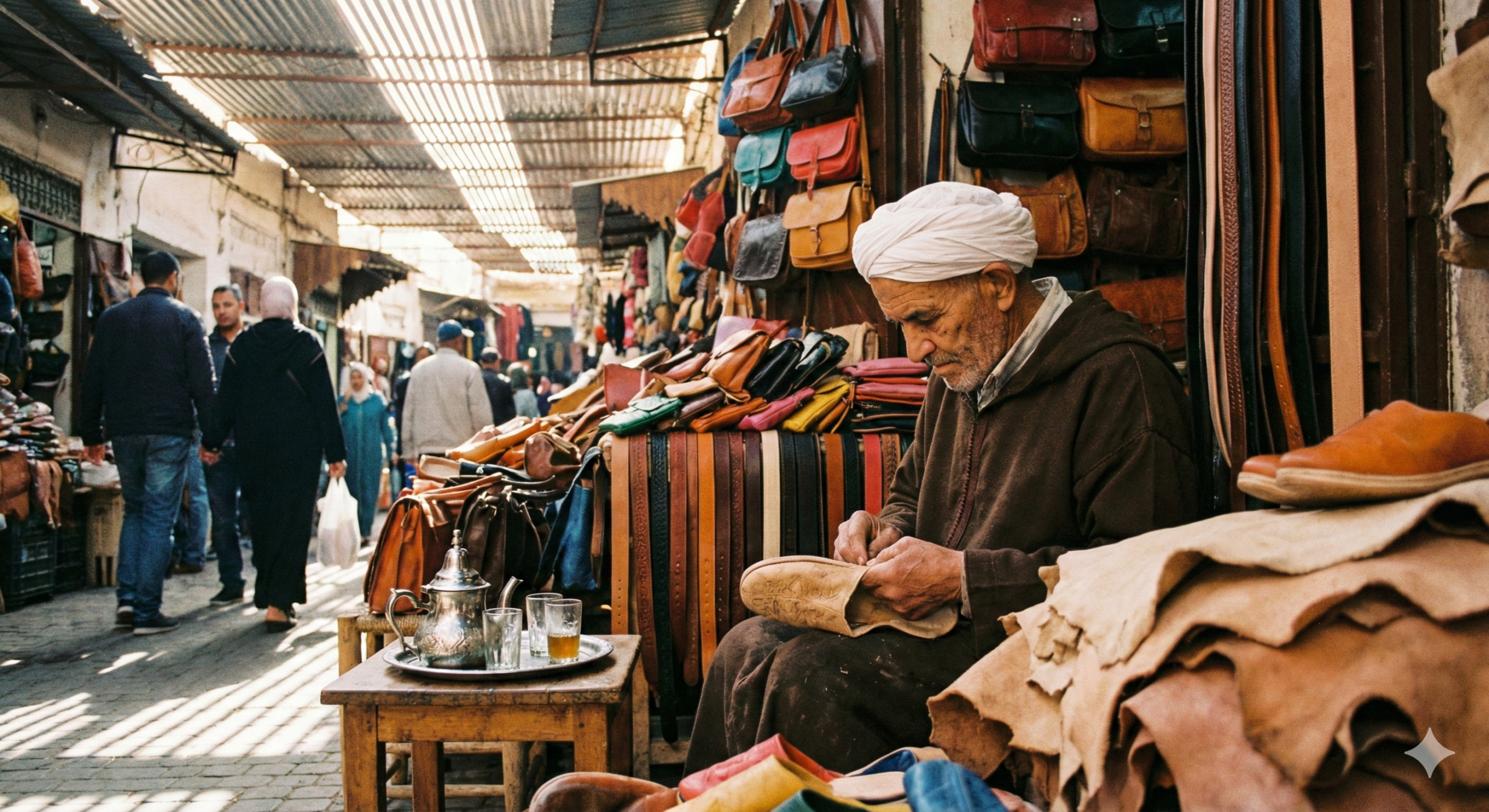
You walk through Gate 6 of Souk El Had, and the first thing you notice is the sun hitting the orange stones of the walls. But for me, after forty years of sitting cross-legged in this stall, I don’t need my eyes to know I am home. I smell it first: the earthy, pungent scent of raw goat leather, the sweetness of burning agarwood from the spice stalls nearby, and the sharp zest of the clementines from the stalls just down the row.
In Agadir, we are different. We are the gateway to the South. My father told me how we rebuilt this place when the earth shook the city to its bones in 1960. This marketplace isn’t just a place to buy a souvenir; it is the physical proof that our culture cannot be broken.
When you ask, “What is a Souk?”, you are not asking for a definition of a shop. You are asking about the rhythm of Moroccan life. To the tourist, it is a labyrinth to get lost in. To me, it is a map where every turn is a neighbor, and every craft is a signature of who we are.
The Language of the Leather
The leather here in the Souss-Massa region tells a story of the mountains. When a traveler picks up a pair of babouches (slippers) in my shop, they see a color—maybe the deep saffron yellow we are famous for. But I see the goats of the Atlas. I see the hands of the tanners who still work the pits as their grandfathers did.
In the souk, we don’t just “sell items.” We curate a lineage. If you see me running my thumb along the grain of a hide, I am checking for the strength that will last twenty years, not just until you get back to the airport. In Agadir, our souk is organized; the leatherworkers sit near the cobblers, and the cobblers sit near the tool-makers. We are an ecosystem. If my neighbor is sick, I watch his stall. If a customer is looking for a spice I don’t have, I walk them to the man who does. That is the “real-time” pulse of the souk—it is a social contract signed in tea and trust.
The Art of the “Zid o Nqas” (The Haggle)
You come to my shop and you see a price. You think it is a battle. You have read your travel blogs and you think you must be “tough.” But listen to an old man who has negotiated a million times: the haggle is not a war, it is a conversation.
When you sit on the stool and I pour the tea—never rush the tea—we are finding a middle ground where both of us leave with our dignity. When you haggle too hard, you are not just saving a few Dirhams; you are telling me you do not value the hours my eyes spent over the stitching in the dim light.
My advice for the modern traveler in Souk El Had:
- Start with “Salaam”: A greeting opens more doors than a wallet.
- Know the “Walk-Away”: If the price doesn’t feel right, walk away with a smile. If I call you back, we have a deal. If I don’t, then that was truly my lowest price.
- Respect the Craft: In the 1980s, we didn’t have many machines. Today, I see many “leather” bags that are made of plastic in factories far away. Look for the imperfections. The soul is in the slight scar on the hide or the uneven stitch of a human hand.
The Changing Winds
Agadir is growing. I see it in the way the young people use their phones to pay and how the cruise ships bring thousands of faces in a single afternoon.
But even as the world speeds up, the souk remains a place where you must slow down. We have survived earthquakes, we have survived modern malls, and we have survived the changing seasons because the human heart still wants to touch what it buys and look the maker in the eye.
Final Thoughts
When you leave Souk El Had through the same gate you entered, I hope your bags are heavy, but I hope your spirit is lighter. You didn’t just buy a bag; you took a piece of my day, a piece of Agadir’s history, and a story you can tell every time someone asks, “Where did you get that?”
Leave a comment