
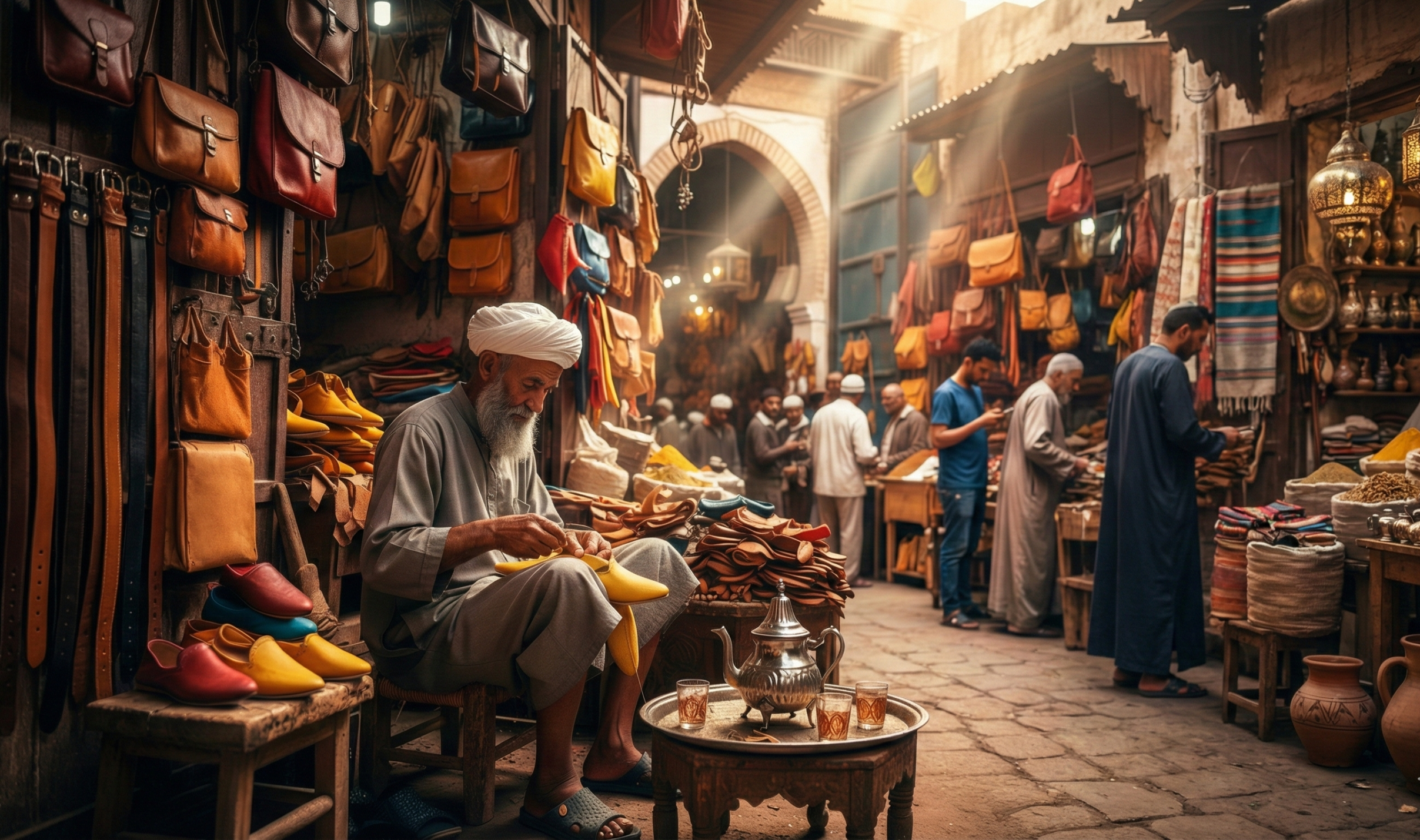
My friend, you ask me what a souk is, and I could tell you it’s simply a marketplace. But that would be like saying the ocean is just water. Let me instead take you by the hand, as I would any honored guest entering my workshop, and show you what twenty years of breathing this air has taught me.
The Morning Pulse
The souk wakes before the sun fully reaches over the ramparts. By eight o’clock, when you tourists are still finishing your hotel breakfast, we have already been at work for two hours. The sound you hear first—before you see anything, before you smell anything—is the hammering. The metal workers in the adjacent quarter begin their rhythm: tang-tang-tang, pause, tang-tang-tang. It’s the heartbeat of the place. Then comes my neighbor the carpenter, his saw singing against argan wood, and somewhere deeper in the labyrinth, the weavers’ looms begin their softer percussion.
I sit on my worn leather stool—the same one my father sat on when he taught me to cut a hide without wasting even a finger’s width—and I pour the first glass of mint tea. This is not the tea you’ll be offered later, when the sun is high and the selling begins. This is our tea, the craftsmen’s tea, bitter and strong with just enough sugar to remind us why we work. The smell of it mixes with the leather oil I’m already massaging into a bag that’s been three days in the making, and with the bread baking somewhere behind the spice seller’s stall. This is how the souk smells at dawn: honest work and simple sustenance.
The Architecture of Respect
You walk through these narrow passages with your camera and your guidebook, and you see chaos. You see men calling out prices, goods spilling from every doorway, the impossibility of straight lines. But we see something else entirely. We see order.
There is a geography here that took centuries to establish. The leather workers—we are in one quarter. Not by accident, but by ancient logic. Our work needs water for the tanning, so we are near the old wells. The metalworkers need fire and ventilation, so they occupy the wider streets where the wind can carry away the forge smoke. The spice merchants sit in the covered passages where the sun won’t spoil their saffron and cumin. This arrangement, it predates any city planner with his clipboard and regulations.
And between us shopkeepers, there exists a web of unspoken rules that keeps everything functioning. When Ahmed the bag maker next to me has a customer examining his work, I don’t call out to that customer. His sale is his sale. When I need to leave my shop to pray or to collect more leather from the tannery, I don’t lock my door—I simply tell Youssef across the way, and he watches both shops. Last month, when the tourist season was slow, we all agreed not to undercut each other’s prices. This wasn’t written in any contract. It was simply understood over many glasses of tea, many conversations that looked like idle gossip but were actually the negotiations that keep our community alive.
The old guilds, the amanat, they’re not as powerful as they were when my grandfather was young, but their spirit remains. When a young man opens a leather shop and tries to sell bags made from cheap synthetic material while claiming they’re genuine goat leather, word spreads faster than fire through dry grass. The customers don’t know the difference, but we do. Within a week, the elder craftsmen will visit him. Not with threats, but with education—and expectation. The reputation of Moroccan leather isn’t just mine to protect; it belongs to all of us, and we guard it jealously.
The River of Time
When I was a boy learning this trade at my father’s elbow, the souk operated on a different clock entirely. Merchants from the interior would arrive with their camel caravans after weeks of travel, the animals’ bells announcing their approach long before they appeared. The excitement of those arrivals—the crowds gathering to see what goods had come from Marrakech or Essaouira, the haggling that would last for hours over a single transaction—it was theater and commerce combined.
My father would tell stories of his father’s time, when there was no electricity at all, when the souk became almost silent after sunset except for the night watchmen making their rounds. The pace of everything was slower then, measured in seasons rather than hours. A customer might come back three or four times over several weeks before deciding to purchase a saddle. This was normal. Expected, even.
Now? Now a young couple from Germany walks into my shop, chooses a bag, pays with a card that talks to a satellite in space, and the transaction is complete in seven minutes. I have a smartphone in my pocket—yes, even an old craftsman like me—and I photograph my work to send to customers in France, in America, in Japan. My son, who works with me now and will inherit this space when I’m gone, he wants to create a website. A website. For a shop that has existed in this exact spot for three generations.
Yet something is being lost in this river of time. The young apprentices don’t want to spend five years learning to hand-stitch a belt when they can buy a machine that does it in five minutes. They don’t understand that the slight irregularity in hand-stitching is not a flaw, it’s proof that human hands, with all their imperfection and care, created this thing. They see the old ways as slow. I see them as thorough.
The tourists have changed too. When I was young, the foreigners who came to the souk were travelers, not tourists. They had time. They wanted to understand. Now many rush through with their phone cameras, taking pictures of everything and seeing nothing. They want the “authentic experience” but they have a bus to catch in forty minutes. How can I show you the soul of this place in forty minutes? How can I explain that this bag you’re examining took three days to create, that the leather came from a tannery my family has worked with for fifty years, that the pattern was taught to me by my father who learned it from his father, in forty minutes?
How to Walk Among Us
So, my friend, you who are reading this—perhaps you’re planning to visit a souk, or perhaps you’ve already walked through one and felt overwhelmed, confused, maybe even cheated. Let me offer you the guidance I would give to anyone I consider a guest in my home, because that’s what the souk is to us who work here. It is our home.
First, understand that when you enter the souk, you’re not entering a museum or a shopping mall. You’re entering a neighborhood where people live and work, where children play between the stalls, where old men sit and discuss politics and religion and whose daughter is marrying whose son. Move through it with the respect you’d show in anyone’s neighborhood.
When a shopkeeper invites you in for tea, know that this is not always a sales tactic, though of course we hope you might buy something. It’s also genuine hospitality. In our culture, the guest is sacred. If you have time, accept the tea. Sit. Talk. Ask about his family, his craft. Tell him about yours. This conversation, this human connection—this is the real transaction, more valuable than whatever you might purchase.
About haggling: yes, we expect it, but understand its purpose. It’s not combat. It’s a dance, a conversation conducted through numbers instead of words. When I quote you a price for a bag, I’m not trying to cheat you. I’m opening a negotiation that allows both of us to feel satisfied. You want to feel you got a fair deal; I want to feel my work was valued. When done with respect and good humor, haggling is enjoyable for both sides. What we don’t enjoy is when someone offers us an insulting price—a tenth of what we asked—as if our work has no value, or when someone haggles us down to our bottom price and then walks away without buying, as if it was all just a game to them.
The maze of passages that confuses you—learn to trust it. Yes, you’ll get lost. Everyone gets lost. But you’ll also stumble upon corners that aren’t in any guidebook: the tiny stall where an old woman sells herbs her grandmother taught her to identify, the courtyard where the children of the souk play football, the workshop where a master woodcarver creates pieces that take six months to complete. Getting lost is not a failure; it’s the point. The souk reveals itself to those who wander with open eyes and patience.
Don’t photograph people without asking. We’re not part of the scenery. Would you want strangers photographing you at your workplace? Some of us don’t mind—I usually don’t, especially if you’ve bought something or shared tea—but ask first. Show respect.
When you see something beautiful—a carpet, a lantern, a piece of pottery—and the price is higher than you expected, remember that you’re not just buying an object. You’re buying years of apprenticeship, generations of accumulated knowledge, hours of patient work. That carpet was woven over months. Those metal lanterns were hammered by hand, each one unique. In your country, you might pay a hundred euros for a machine-made bag that will last two years. Here, you pay the same for a hand-stitched leather bag that will last twenty years and develop character with age, the leather growing softer and richer, carrying the story of your travels in its creases and scars.
The Living Organism
The souk is not dying, though some romantic visitors like to speak of it this way, as if we’re all museum pieces performing a reenactment of the past. No, the souk is changing, as it has always changed, as all living things must change to survive.
When my grandfather was my age, he worried that independence from France would change everything beyond recognition. When his father was my age, he worried that the railroad would end the camel caravans and destroy the traditional trade routes. They were all right—those things did happen. And they were all wrong—the souk adapted, transformed, persisted.
What is a souk? It’s a place where commerce and community are inseparable, where the transaction is never merely transactional. It’s where I know that Ahmed’s son is studying engineering in Rabat, where Fatima who sells olives knows my wife’s mother is ill and always asks after her health, where Ibrahim the spice merchant helped pay for my nephew’s wedding because that’s what neighbors do.
It’s a place that smells like a thousand things at once—leather and saffron, mint tea and diesel fumes, fresh bread and animal musk, jasmine perfume and honest sweat. It sounds like competing calls to prayer from a dozen mosques, like hammers and saws and bargaining and laughter and the whisper of fabric as a woman examines a djellaba.
It’s a maze that makes perfect sense once you understand its logic, a chaos that functions with more efficiency than many modern systems, a throwback to the past that somehow adapts to each new future.
It’s my livelihood and my heritage, my burden and my pride, and my temple.
And you, my friend, you’re always welcome here. Just remember: bring your time along with your money, bring your curiosity along with your camera, bring your respect along with your desire for a bargain. The souk will give you back more than you came for—not just in the things you carry away in your bag, but in the stories you’ll carry in your memory.
Now, if you’ll excuse me, it’s nearly eight o’clock. The hammers are beginning their morning song, and I have a fresh pot of mint tea calling my name. The souk is waking up, and there’s work to be done.
Salam aleikum. May peace be upon you, and may your path through the souk—and through life—be blessed.
Leave a comment